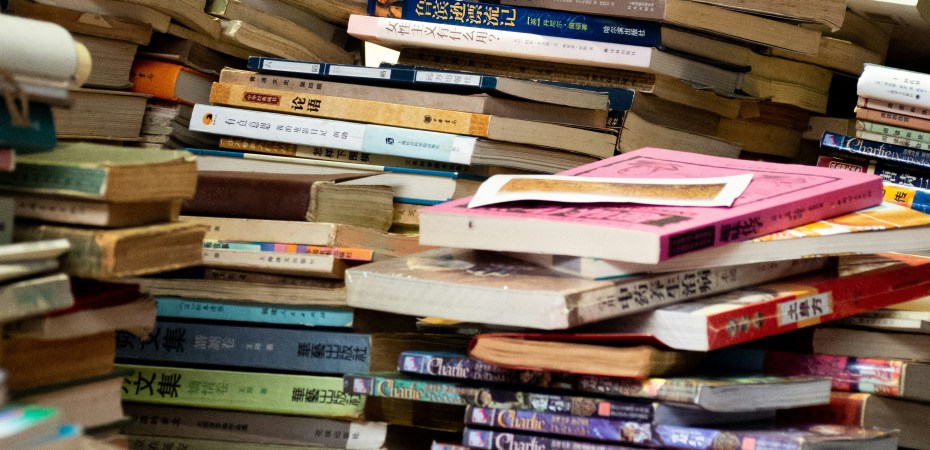
Here we are again! Another year of posting fuck all on this blog, reading instead of writing, and being too caught up with life to sit down and put time into my own life’s work. I take consolation in the fact that each day I spend out there in reality becomes fuel which can one day be burned in the engine of my art, when I finally feel that the time and my mind are right for the task. I will, of course, live forever, and so have plenty of time to fit it all in. Anyway! I read a bunch more books this year, so here they are:
Terry Pratchett – Disc World Books 7 & 8 (Pyramids & Guards! Guards!)
Pratchett once again manages to keep things fresh and interesting somehow even when approaching double digit volumes in this series. With each new novel, new corners of the world are brought to light, new strange and hilarious characters added to the roster. Both of these books were excellent, and I look forward to continuing on. I think so far, my favourites have been the ones about the wizards, and the ones about Death, but the guards are a close third.
Stephen Fry – Odyssey
Reading this book a couple of years after the earlier entries in the series, I was immediately immersed once again in the arcane magic of the old legends, the joyful intelligence of Stephen Fry’s retelling of them, and the pure wonder he instills in me as a reader. He’s bloody-well done it again here, and Odyssey is every bit as charming, funny, and powerful as Mythos, Heroes, and Troy were. It’s a shame that this is the last in the series, but I’m very grateful for what he’s done with these books. I’d recommend this to everyone.
Salman Rushdie – The Satanic Verses
This is a dense, heavy, beautiful, poignant, challenging, and profoundly funny novel, all of which makes the barbaric crusade that it sparked against its author all the more tragic and vile. Salman Rushdie’s intelligence, sensitivity, depth and humour shine through on every page. This book doesn’t hold your hand. It’s hard work sometimes, packed full of high-culture references and layers upon layers of meaning, many of which flew straight over my head, but it was rewarding, astoundingly well-written, strange and powerful in a way few artists can achieve. I guarantee none of the idiot cultists who’ve wished for Rushdie’s death have read this book, much less even begun to understand its beauty, or the depth of humanity it reveals.
Mark Forsyth – The Horologicon
Forsyth’s book, The Etymologicon, is one of my favourite reads of all time, so I don’t know how it took me so long to get around to his others. Etymology is endlessly fascinating to me, and the author’s love of words and joy in studying and discussing them is infectious in both of his works that I’ve read. The Horologicon focuses on archaic, now-defunct words whereas The Etymologicon was more about everyday utterances. I was hooked from start to finish and have since been working hard to integrate such ridiculous specimens as ‘Fumitorium’, and ‘Philogrobilized’ into my daily speech. I’d say, if I was going to recommend only one, I’d tell you to read The Etymologicon, but I can do whatever I want, so read both!
Liam Halligan – Home Truths
I saw Mr Halligan speaking on a podcast a while ago about the reasons why the UK housing market is so shit, and I was entranced. He elucidated many aspects of the corruption and greed driving the insane housing situation in my country that had never occurred to me before, and it all made so much sense. So I bought this book, thinking I’d venture even deeper down the rabbit hole. However, once I entered I was taken on a dizzying round trip covering the same ground again and again and again until I’d gone from engagement to frustration. This book should have been half, maybe a third of the length it was. As interesting as the ideas are, everything is stated, and re-stated, and re-re-re-stated until I was begging for the end, so that when I got there all I really remembered was what an annoying read it was. I’d recommend just watching the podcast.
David Nutt – Psychedelics
After reading professor Nutt’s book on cannabis, I knew I had to read this one too. As a scientist working at the forefront of research into psychedelics for use in the treatment of illnesses such as depression, PTSD, and addiction, there’s no one better to learn from about the latest developments in psychopharmacology. Throughout the book he takes a cautious, evidence-led approach to explaining all that we currently know about these mysterious substances, and he addresses many commonly held myths and misconceptions as well, while accepting the limits of our current knowledge on the topic. He lays out the barriers that have previously held back this type of research, and gives an encouraging account of how they’ve slowly eroded over time. It’s an incredibly exciting time for the field, and I can’t wait to see what comes next.
Cormac McCarthy – The Road
I saw the film of this book a while ago with Viggo Mortensen (he’s in it, he didn’t watch it with me), and it was super depressing. I hadn’t heard of Cormac McCarthy at the time, but when I heard about him later, found out what a literary giant he is, and that that movie was based on this book, I decided to give it a go. It was super depressing, but also a uniquely powerful and stark story, dark, bleak, unrelenting, but soulful, human, and full of a pained, desperate kind of love. I was absolutely hooked and finished it in a couple of days. It left me strongly feeling something, though I’m not sure what. I’ll definitely be reading more of his work.
Jack Kerouac – On The Road
I’d heard the name Jack Kerouac a million times, but I wasn’t sure why. I was vaguely familiar with some of the works of the beat generation, having read Buckowski last year and encountered some of Ginsberg’s poetry at university, and I love Hunter S Thompson (a kind of spiritual successor to them in some ways), so I was glad to finally get around to reading On The Road. It’s incredibly descriptive, though a bit repetitive in my opinion. The pages are bursting with the life, the buzz, the jazz, and the flow of that bygone era of wild freedom that was America back when it was cool and hadn’t lost its mind yet. Being semi-autobiographical, the book’s large cast of characters have an authenticity that makes them seem so real, their flaws so endearing, and their desires so vivid and joyous. I really enjoyed it. It meanders a lot, but that’s sort of the point.
P.G. Wodehouse – Right Ho, Jeeves, The Code of the Woosters, Thank You, Jeeves, Ring For Jeeves, Joy in the Morning & The Mating Season
My god, the genius, the wit, the sheer clarity and ease of expression, the turn of phrase that knocks you over and has you laughing out loud with just a few well-placed words. I finally sank my teeth into Wodehouse’s most celebrated series, and I was not disappointed. These books are timeless masterpieces, hilarious beyond all reason, wonderous and filled with a childlike innocence that should be so hard to sell, but Wodehouse effortlessly brings you along into his world of farce and makes you leave your disbelief behind as these comedies of error unfold. Each sentence a gem, every character a classic, and the glue that holds it all together, the narrative voice of Bertie Wooster soaking into you through the pages like golden honey. It’s the kind of writing that makes you want to hang up the pen, because you’ll never be that good.
Levy Rozman – How to Win at Chess
This is a tricky one to review, I suppose, because it’s sort of a text book. Levy Rozman is better known by his Youtube handle, Gotham Chess, and I’ve enjoyed his content for a long time. I’ve played chess since I was a young boy, with varying levels of success, and his videos have helped me greatly to deepen my understanding of the game and improve my skills. This book, for me, was slightly disappointing however, because it mostly covered the basics. Perhaps a more accurate title would have been ‘How to Play Chess’. But in a way, it’s encouraging, because it showed me how far I’ve come on my own chess journey. And for beginners of the game, I would absolutely recommend it. You couldn’t hope for a better introduction to the rules, core concepts, and basic strategies of chess, complete with plentiful diagrams and visual aids to help you understand what’s being taught. He’s doing another one next year, which will cover some more advanced material, so I very much look forward to reading that.
So, there you have it. Some absolute bangers in there. I once again feel grateful to live in an age where we have easy access to every piece of media ever created by humanity. My bookshelves fill back up quicker than I can empty them, not to mention all the music, films, TV shows, anime, and video games I try to squeeze into my waking hours, as well as occasionally interacting with some actual humans. Despite the mountain of content that threatens to bury me, please comment with your own book recommendations, or reviews of what you read this year, and I’ll add them to the ever-growing heap.
Written and published – January 2026
Photo by Sirius Harrison on Unsplash
 Anxious Planet